
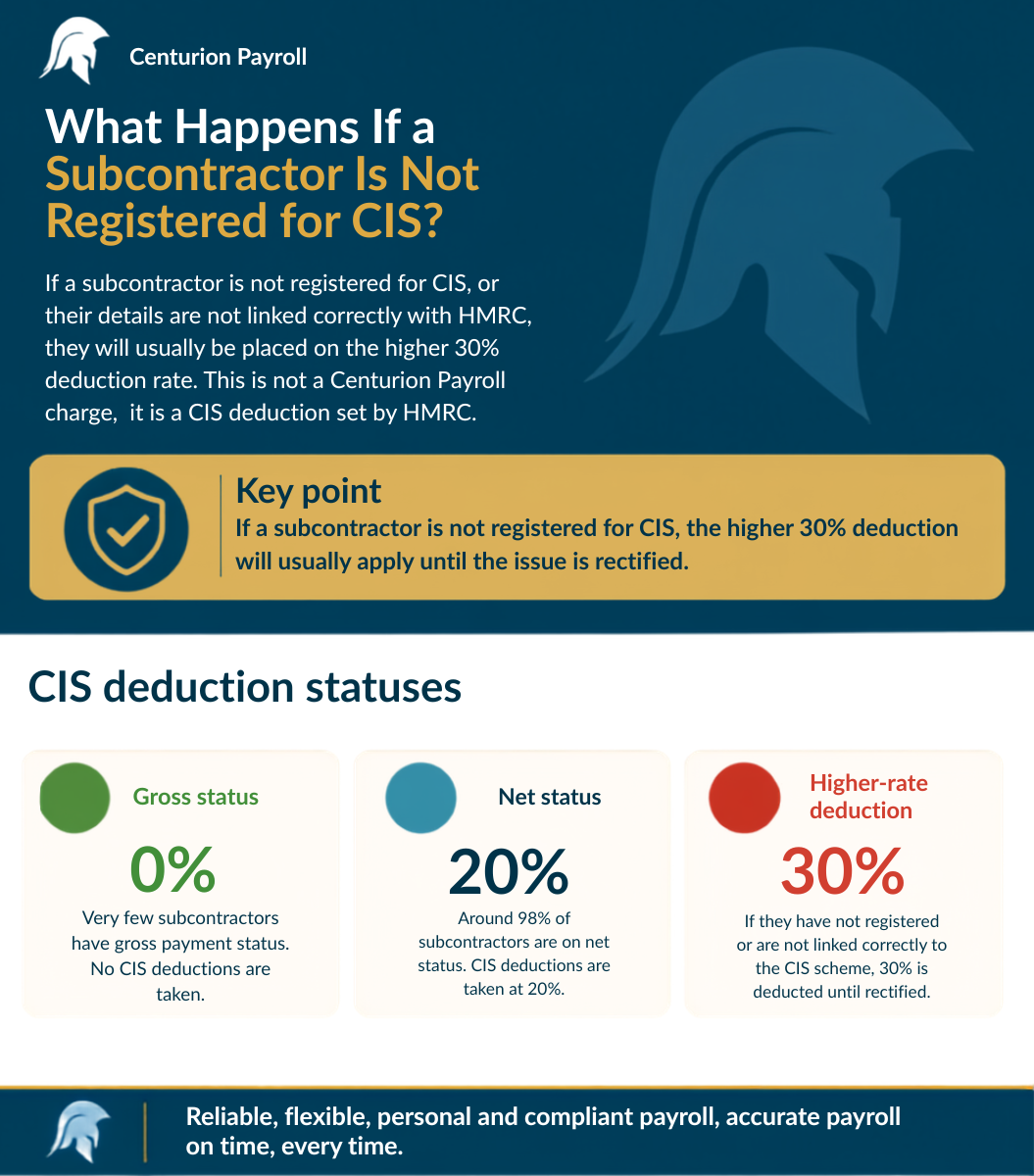
If a subcontractor is not registered for CIS, or their details are not correctly linked with HMRC, they will usually be placed on the higher 30% deduction rate. This is not a Centurion Payroll charge, it is a CIS deduction set by HMRC.
Centurion verifies subcontractors using their name, National Insurance number and UTR number. Once checked, HMRC confirms whether they are on gross status, standard net status or higher-rate deduction. Most subcontractors are on net status, where 20% is deducted, while gross status means no deductions are taken. If the subcontractor is not registered or linked correctly, the 30% deduction usually applies until the issue is rectified.
Read our article, How to Pay Subcontractors on Time Without Running Payroll In-House for more information on the topic.
Outsourcing CIS Payroll to Pay Subcontractors On Time
If a subcontractor is not registered for CIS, or their details are not correctly linked to the CIS scheme with HMRC, they will usually be placed on the higher deduction rate. This means 30% is deducted from their payment instead of the standard 20% deduction that applies to most net-status subcontractors.
It is important to be clear that this is not a Centurion Payroll charge. The higher deduction is a CIS deduction set by HMRC. Centurion’s role is to verify the subcontractor correctly, apply the right deduction status, and make sure everything is handled accurately and compliantly.
If you’re interested in outsourcing CIS payroll for subcontractors, take a look at our article, How to Pay Subcontractors on Time Without Running Payroll In-House.
Why CIS registration matters
CIS payroll applies to payments between contractors, agencies and subcontractors in the construction industry. When a subcontractor is registered and correctly linked to the CIS scheme, HMRC can confirm their deduction status.
Most of our subcontractors are on net status, which means 20% is deducted and paid to HMRC as an advance payment towards tax and National Insurance. A very small number of subcontractors have gross payment status, which means no deductions are taken. However, if a subcontractor is not registered or their CIS status has not been linked correctly, they will usually be placed on the higher 30% deduction rate until the issue is rectified.
What Centurion needs to verify a subcontractor. To verify a subcontractor, we just need their:
- Name
- National Insurance number
- UTR number
Once these details are provided, the subcontractor can be checked with HMRC to confirm whether they should be paid under gross status, standard net status, or higher-rate deduction.
This is why it is important for subcontractors to apply with HMRC, obtain their UTR number, and make sure they are linked to the CIS scheme before payment is due.
CIS Deduction Status Checker
What CIS Deduction Rate Might Apply?
Use this quick checker to understand what may happen if a subcontractor is not registered for CIS, has missing details, or has not been linked correctly with HMRC.
Subcontractor details
HMRC verification
- Name
- National Insurance number
- UTR number
Once checked, HMRC confirms whether the subcontractor is gross status, net status or higher-rate deduction.
Your result
To confirm the correct CIS deduction rate, the subcontractor needs to be verified using their name, National Insurance number and UTR number.
Can an unregistered subcontractor still be paid?
In many cases, the issue is not that the subcontractor cannot be paid, but that the wrong or incomplete CIS status leads to a higher deduction. If they are not registered or their CIS record has not been linked properly, the 30% deduction will usually apply until it is corrected.
We regularly deal with new CIS registrations, often one or two each week, so this is a common situation. The key is making sure the right details are collected early and that the subcontractor understands why the higher deduction has been applied.
Why the 30% deduction happens
The 30% deduction is not a penalty from Centurion, and it is not an additional payroll fee. It is the higher CIS deduction rate applied when HMRC cannot confirm that the subcontractor is correctly registered or linked under the scheme.
For agencies and contractors, this is where using a specialist CIS payroll company can help. Centurion can verify the subcontractor, apply the correct deduction rate, process payments, provide pay advice, and make sure the correct deductions are handled through HMRC.
Dave, Managing Director of Centurion Payroll, explains:
“If a subcontractor has not registered for CIS, or their details are not linked correctly with HMRC, they will normally be placed on the higher 30% deduction rate. That is not a Centurion charge, it is the HMRC CIS deduction. Our job is to keep the process simple, verify the worker properly and make sure the correct deductions are applied.”
How to avoid higher deductions
The best way to avoid higher deductions is to make sure subcontractors have registered with HMRC, have their UTR number ready, and are linked to the CIS scheme before their first payment is due.
For agencies, this means collecting the correct details as early as possible. For subcontractors, it means checking their CIS registration status before starting work or before the first pay run.
To Summarise
If a subcontractor is not registered for CIS, they will usually have 30% deducted rather than the standard 20%. This is not a Centurion Payroll charge, it is the higher CIS deduction set by HMRC.
Centurion helps by verifying the subcontractor’s name, National Insurance number and UTR number, applying the correct deduction status, and making sure payments and deductions are processed accurately, compliantly and on time.
Read the following article to find out more about The Differences Between Agencies, Contractors and Subcontractors.