
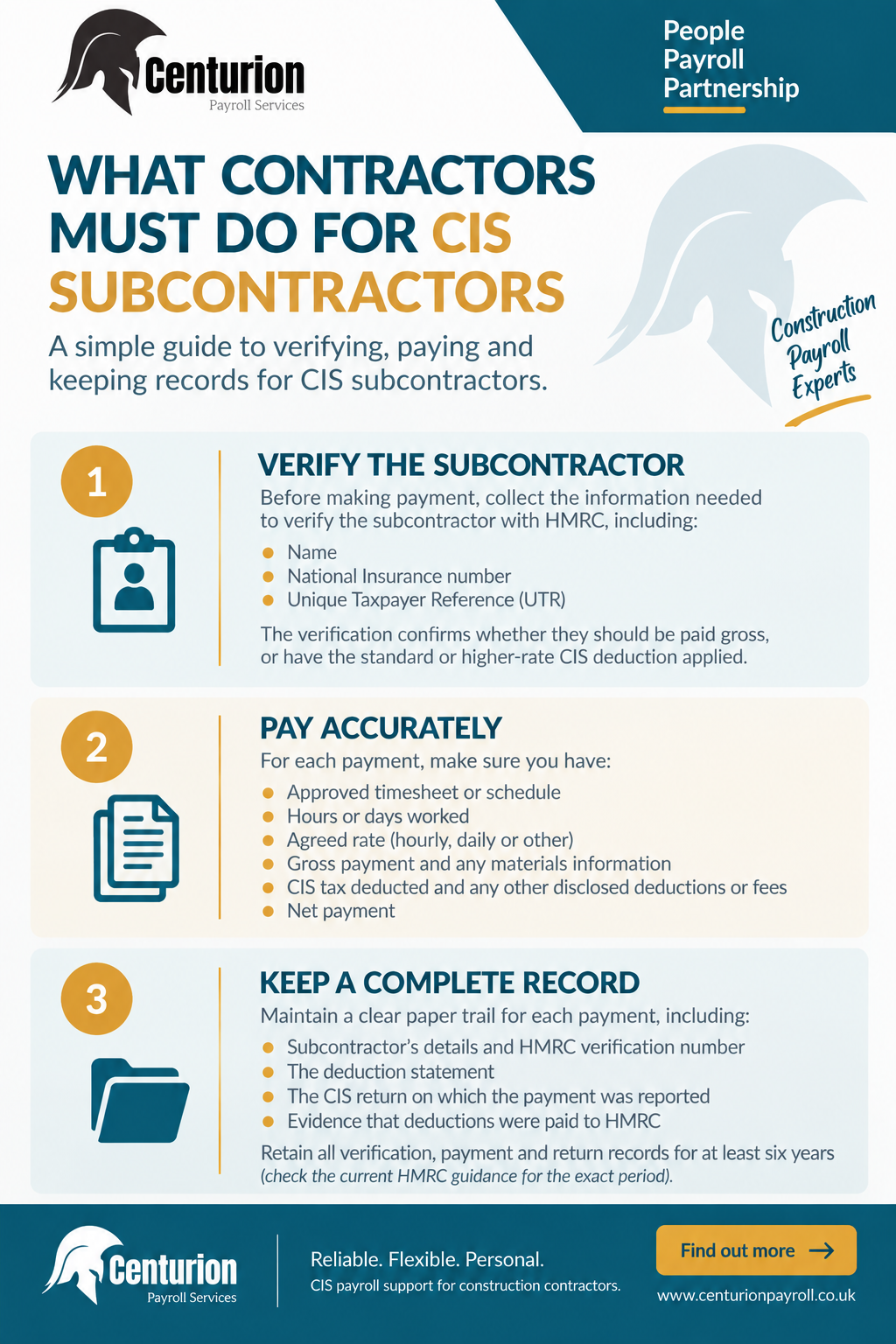
Contractors paying CIS subcontractors need to verify each worker correctly, process payments using accurate information and make sure clear records are being kept of every stage.
Before payment, the subcontractor’s details, including their name, National Insurance number and UTR, should be collected for HMRC verification. The result determines whether they are paid gross or have the appropriate CIS deduction applied.
For each payment, contractors should keep records covering the approved timesheet or schedule, hours or days worked, agreed rates, gross payment, relevant materials information, CIS and other disclosed deductions, and the final net payment.
Records should also connect each payment to the HMRC verification, deduction statement and corresponding CIS return, with evidence that deductions have been paid to HMRC.
The aim is to maintain a complete, consistent paper trail from verification through to payment and reporting.
More than just calculating deductions
Paying subcontractors through the Construction Industry Scheme involves more than calculating a deduction and transferring the money.
For contractors, the process starts with collecting the correct subcontractor information and completing HMRC verification. From there, each payment needs to be supported by accurate information about the work completed, the agreed rate, the gross amount, any CIS deduction and the final net payment.
Just as importantly, contractors need to retain a clear record of what has happened.
The aim is to maintain a complete paper trail from the initial verification through to the payment, deduction statement and corresponding CIS return.
At Centurion Payroll, our role is to help make that process reliable, accurate and straightforward, ensuring the information required for payroll is properly brought together and workers are paid correctly and on time.
Is this CIS payment ready?
Tick each step as you complete it.
Verify
Pay
Record
Work through the checklist to build a clear CIS payment record.
This checklist is a simple reference based on the payroll process described above and is not a substitute for individual compliance advice.
What information is needed to verify a CIS subcontractor?
Before a subcontractor is paid, the contractor needs enough information to complete the appropriate verification with HMRC.
The information the tax man will need includes the subcontractor’s:
- Name
- National Insurance number
- Unique Taxpayer Reference (UTR)
The verification result establishes how the subcontractor should be treated for CIS deductions.
Verification can establish that a subcontractor has gross payment status, the standard 20% deduction or the higher 30% deduction.
This is an important first step because contractors shouldn’t simply assume that every subcontractor should have 20% deducted. The appropriate treatment comes from the verification.
If the information supplied is incomplete or incorrect, that can create problems before the payment process has even begun.
Keep a record of the HMRC verification
Verification isn’t simply something to complete and then forget about. The contractor should retain the information associated with that verification as part of the subcontractor’s payroll record.
This includes the subcontractor’s identity and contact information, National Insurance number and UTR, together with the HMRC verification number and resulting deduction status.
Keeping that information provides the first part of the paper trail. It connects the person or business being paid with the HMRC verification used to determine how their CIS payment was treated.
Make sure the payment starts with accurate information
Once the subcontractor has been verified, the contractor needs accurate information about the work being paid for.
Our payroll process is based around receiving a payment schedule containing the information required to calculate and process the worker’s payment. That includes details such as the worker’s name, approved hours or days and the applicable hourly or daily rate.
Additional information contractors should retain for each payment includes:
- Approved timesheet or payment schedule
- Hours or days worked
- Hourly, daily or other agreed rate
- Gross payment
- Relevant materials information, where applicable
- CIS tax deducted
- Any other disclosed deductions or fees
- Net amount ultimately paid
Keeping these pieces of information together makes it possible to see how the final payment was reached, rather than retaining only the net figure that reached the subcontractor.
Apply the verification result to the payment
The HMRC verification and payment information then need to come together.
If the subcontractor’s verification establishes the relevant deduction status, that status needs to be reflected correctly when their payment is processed.
This is one reason accurate records matter. The contractor should be able to connect the HMRC verification with the gross payment, the deduction applied and the resulting net amount.
At Centurion, our payroll process is designed around making sure workers are paid accurately and on time. Once the required information and funds have been received, payments can be processed using Faster Payments, with the worker receiving information about their payment and pay advice.
Dave Davies, Managing Director of Centurion Payroll, explains:
“With CIS, it’s important that there’s a clear paper trail from the moment a subcontractor is verified through to the payment and the return. You need to be able to show who was paid, how they were verified, what was deducted and where that payment was reported.”
Provide and retain the corresponding deduction statement
The payment itself isn’t the end of the process. Contractors should also retain the corresponding deduction statement for the subcontractor.
That statement forms another part of the overall CIS record, showing the information associated with what the subcontractor has been paid and deducted.
Our process includes providing workers with payment information and password-protected pay advice, helping ensure the worker also has a clear record of their payment.
The important point for the contractor is consistency: the information on the payment records and deduction statement should form part of the same overall record.
Keep the payment connected to the CIS return
It’s incredibly important to maintain the full paper trail rather than viewing verification, payroll and reporting as separate tasks.
For each payment, contractors should retain details of the CIS return on which that payment was reported. That gives the contractor a record that can be followed through the following steps:
- Subcontractor
- HMRC verification
- Timesheet or schedule
- Gross payment
- CIS deduction
- Net payment
- Deduction statement
- CIS return
Contractors should also retain evidence showing that the CIS deductions were subsequently paid to HMRC.
That creates a much more complete record than simply keeping a spreadsheet showing how much each subcontractor received.
To find out more, check out our previous post on the challenges of CIS payroll
Why is a complete CIS paper trail important?
A good CIS record should allow the contractor to understand what happened without having to piece information together from different places.
If you look back at a particular subcontractor’s payment, you should be able to identify who was paid, how they were verified, what work or payment schedule supported the amount, which deduction was applied and where that payment was subsequently reported.
This becomes particularly important when a contractor is dealing with multiple subcontractors. Different people may have different rates, hours, verification results and payment amounts. New subcontractors may also join at different points in a project.
A consistent process makes it easier to keep control of that information from one pay run to the next.
What should a contractor’s CIS records contain?
A contractor’s records should allow them to follow the complete journey of a subcontractor payment.
For each subcontractor and relevant payment, that means retaining the identifying and verification information, approved timesheet or schedule, hours or days, rates, gross payment, relevant materials information, CIS deduction, other disclosed deductions or fees, net payment and deduction statement.
That should then connect with the appropriate CIS return and evidence relating to the payment of deductions to HMRC.
It may sound like a lot of individual information, but a lot of this is information already required at different stages of verification and payroll.
The key is keeping it together in a clear and consistent way.
CIS reporting is an ongoing responsibility
CIS reporting follows a monthly cycle. In practice, Centurion prepares the relevant returns around the 6th of the month, with the payment of CIS deductions to HMRC then due by the 22nd. This means contractors need to make sure their verification, payment and deduction records are accurate and up to date throughout each pay period, so the information needed for the monthly return is ready when required.
This means record keeping shouldn’t be treated as something to catch up with months after payments have been made.
The information used for verification and payroll needs to feed into the contractor’s ongoing reporting, with the relevant records retained afterwards.
Contractors should maintain the full paper trail connecting the subcontractor’s verification, payments, deductions and CIS returns, as well as evidence that deductions have been paid to HMRC.
These records should be retained for a minimum of six years, giving the contractor a clear historical record of how subcontractors have been verified, paid and reported.
How does Centurion help with CIS payroll?
For contractors already managing construction projects and subcontractor relationships, maintaining this process alongside everything else can become another significant administrative responsibility.
That’s where specialist payroll support can help. Centurion Payroll is an independent, family-run CIS payroll company focused on providing a reliable, flexible and personal service. Our established process is designed to bring the necessary payroll information together, process payments accurately and provide workers with clear payment information.
Rather than an impersonal call-centre approach, Centurion provides clients with a regular point of contact and works around the payroll schedule that suits the individual business.
For us, good CIS payroll isn’t simply about making a payment. It’s about making sure the verification, payment information, deductions and records all connect properly from beginning to end.
When those foundations are in place, contractors have a much clearer payroll process and a reliable record of how each subcontractor has been paid.