
Paying construction workers is more complicated because the challenge isn’t simply calculating CIS deductions. Agencies must first establish whether a worker is genuinely self-employed, considering factors such as Supervision, Direction and Control (SDC), before deciding whether they should be paid through CIS or PAYE.
Workers must also be correctly verified with HMRC, while agencies need to manage timesheets, different rates and hours across a workforce that can change quickly between sites and assignments.
The CIS calculation itself is relatively straightforward. The complexity comes from managing employment status, compliance, verification, accurate records and communication while ensuring every worker is paid correctly and on time.
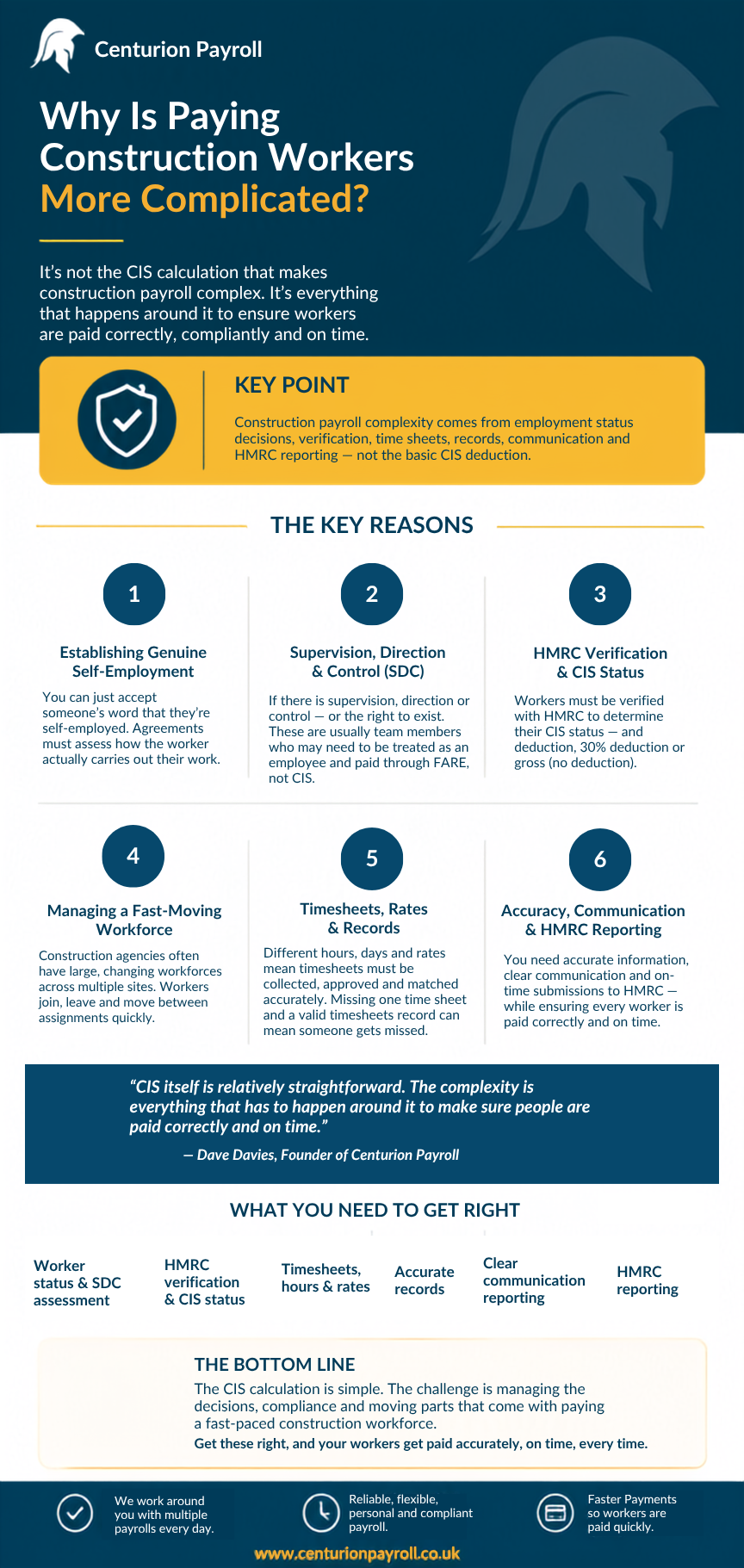
Paying construction workers is not necessarily more complicated because of the CIS calculation itself. In our experience at Centurion Payroll, the Construction Industry Scheme is actually a relatively straightforward system. The complexity comes from everything surrounding the payment: establishing the worker’s correct employment status, completing the necessary verification and compliance work, managing timesheets and records, and making sure a fast-moving workforce is paid accurately and on time.
CIS was designed for the realities of construction
The Construction Industry Scheme was introduced in 1971 to address tax evasion in an industry that historically had a highly transient workforce and widespread cash-in-hand payments.
Construction has always been different from many other sectors. Workers can move between contractors, projects and sites, and the nature of the workforce was one of the reasons a specific system was needed for collecting tax.
CIS provides that system. Contractors make deductions from payments to self-employed subcontractors, which are then passed to HMRC as advance payments towards the subcontractor’s tax and National Insurance liabilities.
The mechanics of making that deduction are relatively straightforward. The more difficult question is whether somebody should be paid through CIS in the first place.
Is this worker ready to be paid through CIS?
Work through the key checks before processing a construction worker through CIS.
This checklist is a practical guide only. Completing every step does not, on its own, establish that an individual is self-employed or eligible to be paid through CIS.
You can’t simply take somebody’s word that they’re self-employed
Before paying somebody through CIS, a recruitment agency needs to establish that the individual is genuinely self-employed.
It isn’t enough for a worker to say, “I’m self-employed.” The agency, sometimes alongside its client, needs to look at the reality of the assignment and how that individual carries out their work.
One of the important considerations is Supervision, Direction and Control (SDC).
Supervision concerns whether somebody oversees the worker and checks that the work is being completed correctly.
Direction concerns whether somebody tells or guides the worker as to how the work should be carried out.
Control concerns whether somebody determines what work the individual does and how, when or where they do it, aside from necessary matters such as health and safety requirements and project logistics.
Importantly, all three don’t have to be present. If somebody is subject to supervision, direction or control (or there is a right for somebody to exercise it) their employment status needs to be considered accordingly. Where SDC applies, the worker may need to be treated as an employee and paid through PAYE rather than as a self-employed subcontractor through CIS.
This is one of the reasons construction payroll requires more than simply calculating a deduction and transferring the money. The decision about how somebody should be paid has to be right before the payroll process begins.
To learn more about how to prove you’re genuinely self employed, read our blog post.
Workers also need to be verified correctly
Once it has been established that somebody can genuinely be paid as a self-employed subcontractor, the appropriate CIS verification still needs to take place.
At Centurion, when a worker registers with us for CIS payroll, we verify their Unique Taxpayer Reference with HMRC using their UTR and National Insurance number.
HMRC’s verification determines the appropriate CIS deduction status. Depending on that status, a worker may have the standard 20% deduction applied, the higher 30% deduction, or have gross status with no CIS tax deducted.
Again, none of those individual steps is necessarily complicated. The challenge is making sure they have all been completed correctly for every worker.
Construction workforces move quickly
The practical realities of construction recruitment add another layer.
An agency might have 30, 40 or 50 workers spread across different sites and assignments. Those individuals can work different numbers of hours, be paid different rates and move on and off assignments quickly.
Before payroll can be processed, the agency needs to know who has worked, where they have worked, how many hours or days they have completed and what rate they should receive.
Timesheets therefore matter enormously.
If you’re processing 50 workers and receive 49 timesheets, it can be surprisingly easy for that missing worker to be overlooked. From a payroll perspective, that’s one missing piece of information. From the worker’s perspective, however, it means they haven’t been paid.
At Centurion, agencies send us a payment schedule showing information including each worker’s name, hours or days worked and hourly or daily rate. We invoice the agency based on that schedule and contact workers to confirm the hours that have been approved and when they can expect payment.
It is a process that relies on accurate information and good communication between the worker, agency, client and payroll provider.
Dave Davies, Managing Director of Centurion Payroll, explains:
“The CIS calculation itself isn’t the complicated part. It’s making sure the worker is being paid in the right way, and that everything around that payment is accurate and compliant.”
There is very little room for error
Construction workers expect to be paid correctly and when promised, just like anybody else. But when you’re dealing with a large and regularly changing workforce, a small administrative mistake can quickly become a significant problem.
That’s why speed and communication matter alongside compliance.
At Centurion, we run multiple payrolls every day of the week rather than requiring every agency to meet one fixed weekly payroll deadline. Once we receive cleared funds from the agency, payments are processed immediately using Faster Payments. Workers also receive confirmation of the amount paid and a pay advice showing their payment and deductions.
As a small, independent, family-run payroll company, we also believe clients should be able to speak to somebody who understands their business. Agencies have a regular point of contact, and Dave is available for urgent enquiries outside normal office hours.
That becomes particularly valuable when something changes at the last minute or a worker has a query about their pay.
The calculation isn’t the complicated part
So, why is paying construction workers more complicated than payroll in other recruitment sectors?
It isn’t necessarily because CIS itself is difficult.
The complexity is everything that surrounds it.
You have to establish whether somebody is genuinely self-employed. You have to consider Supervision, Direction and Control. You have to verify the worker correctly with HMRC and apply the appropriate CIS treatment. You then have to manage timesheets, rates, records and communication across a workforce that can change rapidly between sites and assignments.
And after all of that, everybody still needs to receive the correct payment at the right time.
For us, that’s what specialist construction payroll is really about: taking care of those moving parts so that recruitment agencies can concentrate on their clients and workers, while we concentrate on getting their payroll right.
Pingback: When Should An Agency Consider Outsourcing CIS Payroll?