
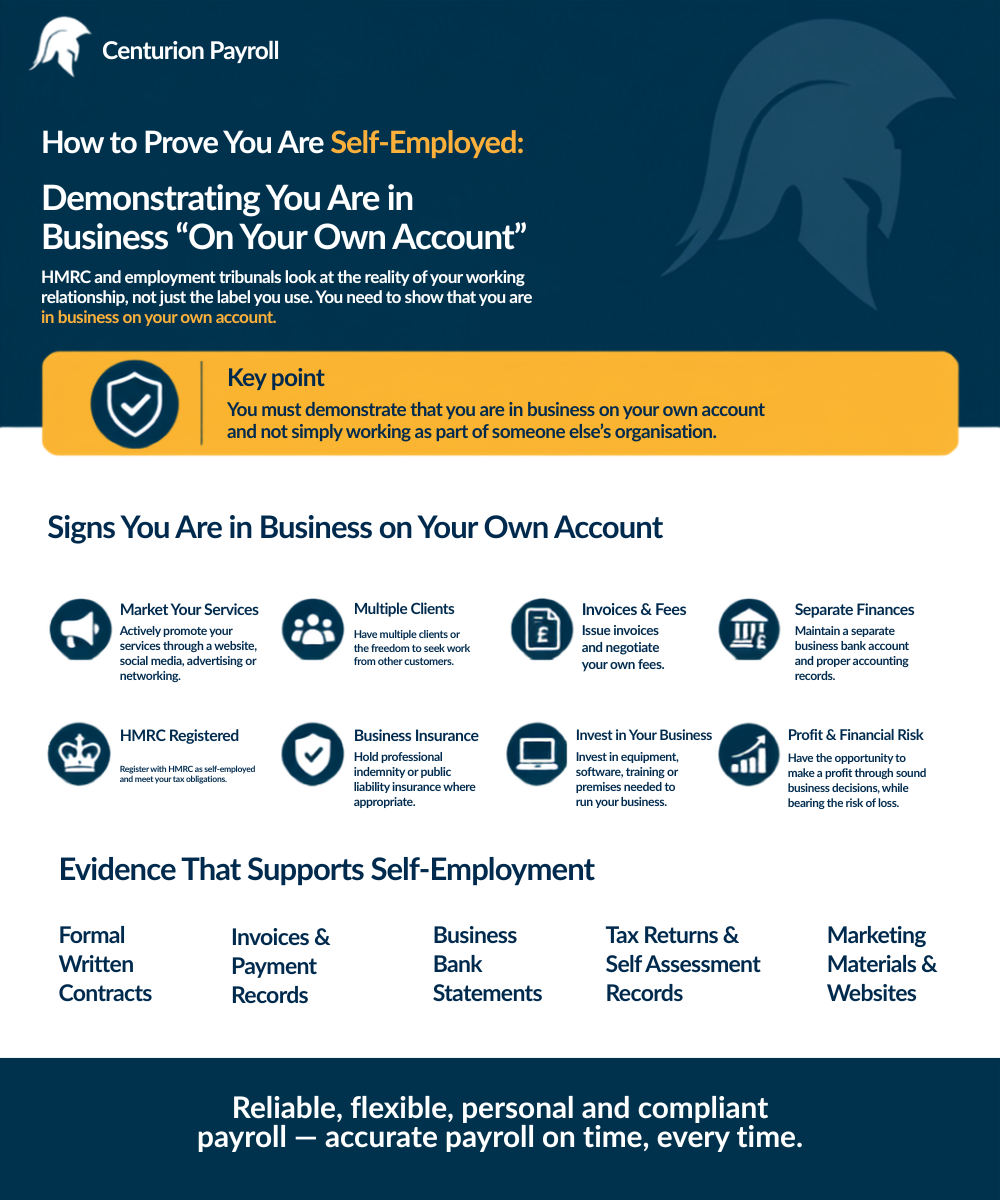
To prove you are self-employed, you need to show that you are genuinely in business on your own account. Simply calling yourself self-employed, or having a contract that describes you that way, is not enough. HMRC and employment tribunals look at the reality of how you work.
Evidence of genuine self-employment can include having multiple clients, marketing your services, setting or negotiating your fees, issuing invoices, maintaining business records, holding appropriate insurance, investing in your own equipment and bearing the risk of making a profit or loss.
Other important factors include how much control you have over your work, whether you can provide a substitute, whether you are free to accept or decline work, and how integrated you are into the client’s organisation.
Useful evidence includes contracts, invoices, bank statements, tax records, insurance certificates, marketing materials and records of business expenses.
Ultimately, no single factor determines your status. HMRC and tribunals consider the overall working relationship and whether it demonstrates that you are operating a genuinely independent business.
Whether you are dealing with HMRC, an employment tribunal, or another organisation assessing your employment status, it is not enough simply to describe yourself as a self-employed contractor. The law looks beyond labels and examines the reality of the working relationship.
One of the key questions is whether you are in business on your own account. This principle, established through case law, considers whether you operate an independent business that provides services to clients, rather than working as part of someone else’s organisation.
Employment tribunals and HMRC consider a range of factors when determining employment status. No single factor is decisive; instead, all of the circumstances are considered together.
Business on Your Own Account
Evidence that you are in business on your own account may include:
- Actively marketing your services through a website, social media, advertising or networking.
- Having multiple clients or the freedom to seek work from other customers.
- Issuing invoices and negotiating your own fees.
- Maintaining a separate business bank account and proper accounting records.
- Registering with HMRC as self-employed and meeting your own tax obligations.
- Holding professional indemnity or public liability insurance where appropriate.
- Investing in equipment, software, training or premises needed to run your business.
- Having the opportunity to make a profit through sound business decisions, while also bearing the risk of financial loss.
These are all indicators that you are a contractor or subcontractor operating an independent business rather than simply working under another person’s direction.
Interactive checklist
How strong is your self-employed evidence?
Tick the evidence that reflects how you currently operate. No single item determines your employment status.
This checklist is a general guide only. Employment status is determined by the full working relationship, not by a score or any single factor.
Other Employment Status Tests
Being in business on your own account is only one part of the legal assessment. HMRC and employment tribunals will also consider several other well-established factors:
Control
A genuinely self-employed contractor or subcontractor will usually have a significant degree of control over how, when and where the work is carried out. If the engager dictates working hours, methods, supervision and day-to-day activities, this may point towards employment.
Personal Service and Substitution
If you are required to perform the work personally and cannot send someone else to do it, this may suggest employee or worker status. By contrast, a genuine and practical right to provide a suitably qualified substitute is often an indicator of self-employment, although the right must be real and capable of being exercised.
Mutuality of Obligation
Tribunals consider whether the engager is obliged to provide work and whether the individual is obliged to accept it. A continuing obligation on both sides is more consistent with employment, whereas genuine self-employed contractors are often free to accept or decline work and clients are not required to offer further engagements.
Financial Risk
Self-employed individuals typically bear commercial risk. They may need to correct defective work at their own expense, invest in equipment, pay their own business costs, and face the possibility of making either a profit or a loss.
Integration into the Business
Someone who is fully integrated into an organisation (for example, appearing on organisational charts, receiving employee benefits, or being managed in the same way as employees) may be more likely to be regarded as an employee. Independent contractors generally operate their own business alongside, rather than within, the client’s organisation.
Dave, Managing Director of Centurion Payroll, explains:
“Being self-employed is about more than what it says on your contract. It’s about how you actually operate day to day. If you’re genuinely running your own business, the way you work and the evidence you keep should reflect that.”
Demonstrating Your Status
If you need to prove that you are self-employed, documentary evidence is invaluable. Useful documents include:
- Written contracts.
- Invoices and payment records.
- Business bank statements.
- Tax returns and Self Assessment records.
- Marketing materials and business websites.
- Insurance certificates.
- Evidence of multiple clients.
- Records of business expenses and investment in the business.
Read the following article to find out more about The Differences Between Agencies, Contractors and Subcontractors.
The Overall Picture
The courts have consistently emphasised that employment status cannot be determined by any single factor or contractual label. Instead, HMRC and employment tribunals assess the entire working relationship to determine whether, viewed as a whole, the individual is genuinely in business on their own account.
For anyone seeking to establish self-employed status, the strongest evidence is a combination of contractual terms and day-to-day working practices that consistently demonstrate the operation of an independent business. Ultimately, it is the reality of the relationship, not the description given to it, that determines employment status.
Pingback: What Responsibilities Does An Agency Have Paying CIS Subcontractors?
Pingback: Why Is Paying Construction Workers More Complicated?
Pingback: What Are The Most Common CIS Payroll Mistakes Agencies Make?