
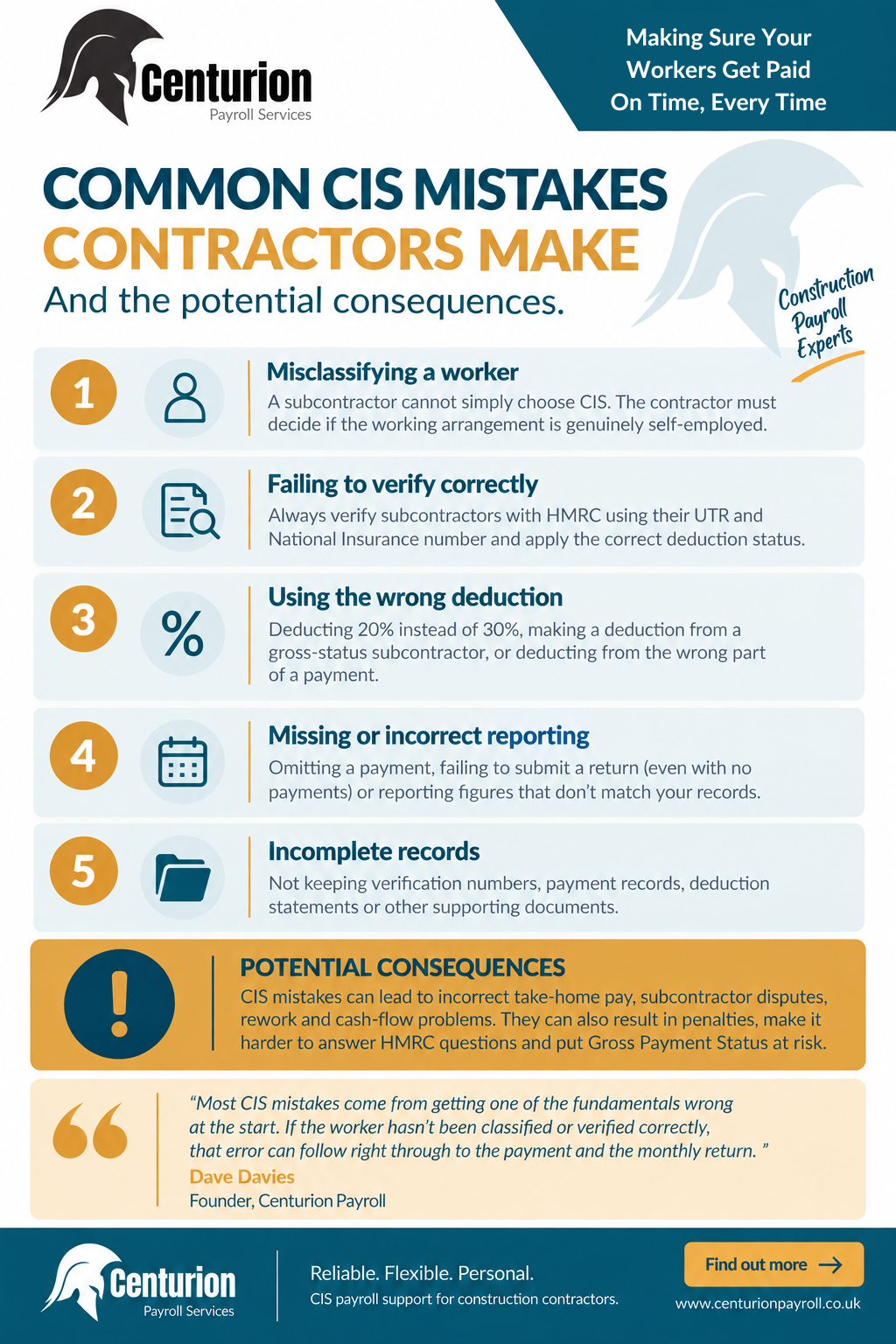
Common CIS mistakes include misclassifying workers, failing to verify subcontractors, using an outdated deduction status and applying the wrong CIS deduction.
Contractors can also make errors by omitting payments from monthly returns, failing to account for months with no payments or keeping incomplete records.
A subcontractor cannot simply choose to be paid through CIS. The contractor must first establish that the working arrangement is genuinely self-employed before verifying the subcontractor with HMRC and applying the appropriate deduction status.
Contractors should also maintain a clear paper trail connecting verification, payments, deductions, statements and CIS returns.
Mistakes can result in incorrect take-home pay, subcontractor disputes, additional administration, cash-flow problems and potential penalties. Poor verification and weak supply-chain records can also make it harder to respond to HMRC queries and may put Gross Payment Status at risk.
For more information, if you are an Agency, read our blog post about common agency mistakes.
How small CIS mistakes can create bigger problems
The Construction Industry Scheme can be relatively straightforward when the correct information and processes are in place. The problems tend to arise when one of those steps is missed, based on an assumption or not properly recorded.
For contractors, common CIS mistakes can begin before a subcontractor has even been paid. Misclassifying a worker, failing to verify them correctly, using the wrong deduction status or processing incomplete payment information can mean the payment is wrong from the outset.
There are then ongoing responsibilities around deductions, monthly returns, deduction statements and record keeping.
At Centurion Payroll, our focus is on making CIS payroll reliable, accurate and compliant. That means looking beyond the calculation itself and making sure the information and records surrounding each payment are right too.
If you are an agency worker, read our blog post about common mistake agencies can make.
Could there be a gap in your CIS process?
Tick anything that applies to your current process.
Tick anything that reflects how your CIS payroll is currently managed.
This checklist is a simple guide to common CIS payroll mistakes and is not a substitute for individual compliance advice.
Mistake 1: Assuming a subcontractor can simply choose CIS
One of the most important mistakes happens before payroll even begins.
A subcontractor cannot simply decide that they want to be paid through CIS. The contractor or agency has a responsibility to consider the reality of the working arrangement and whether the individual is genuinely self-employed.
An independent contractor is someone who is considered self-employed and the paying business should control or direct the result of the work rather than precisely what will be done and how it will be done.
Supervision, Direction and Control (SDC) is an important consideration here.
Somebody can only be treated as a self-employed subcontractor where they operate without Supervision, Direction or Control (or a right for those things to be exercised). Importantly, all three don’t have to be present for SDC to apply.
If the working arrangement has been classified incorrectly, the problem therefore goes further than an incorrect CIS percentage. The worker may have been paid through the wrong system from the beginning.
Mistake 2: Failing to verify a subcontractor properly
Once you’ve established that somebody can appropriately be paid as a self-employed subcontractor, they still need to be verified correctly.
At Centurion, HMRC verification uses the subcontractor’s Unique Taxpayer Reference (UTR) and National Insurance number. That verification establishes whether the worker has standard 20% deductions, higher-rate 30% deductions or gross status, where no CIS tax is deducted.
Failing to complete that verification (or relying on incomplete or incorrect information) can therefore affect the amount deducted from the worker’s payment.
This is why having a UTR shouldn’t be treated as the end of the process. The details need to be used to establish the appropriate status.
Mistake 3: Automatically deducting 20%
Another common mistake is treating 20% as the default answer for everybody being paid through CIS.
Despite what you may think, there are different possible outcomes following verification. A fully registered subcontractor may have the standard 20% deduction, an unregistered subcontractor may be subject to the higher 30% deduction, while somebody with gross status may have no CIS tax deducted.
That creates several possible errors.
A contractor might deduct 20% when the appropriate status requires 30%. Equally, they could make a deduction from somebody who has gross status.
Either way, the payment received by the subcontractor will be wrong.
Mistake 4: Using an outdated deduction status
Verification also needs to reflect the subcontractor’s relevant status rather than relying indefinitely on what the contractor has previously recorded. Using an outdated deduction status is another way contractors can get CIS payroll wrong.
This demonstrates why good payroll records aren’t just about storing historic information. Contractors need to be confident that the information being used to process a payment is the appropriate information for that subcontractor.
Otherwise, even an accurately calculated payment could be calculated using the wrong starting point.
Dave Davies, Managing Director of Centurion Payroll, explains:
“Most CIS mistakes come from getting one of the fundamentals wrong at the start. If the worker hasn’t been classified or verified correctly, or you’re working from the wrong deduction status, that error can follow right through to the payment and the monthly return. That’s why having a consistent process and keeping the full paper trail is so important.”
Mistake 5: Getting the CIS deduction itself wrong
Even where the correct status has been established, contractors still need to calculate the payment using the correct information. Some mistakes we commonly see are deducting CIS from the wrong part of a payment and failing to record materials separately where relevant. That matters because a payment isn’t necessarily just one simple figure.
Contractors need sufficient information to understand what is being paid and how the CIS deduction has been calculated. The payment records should then clearly show the gross amount, relevant materials information, CIS deducted, any other disclosed deductions or fees and the resulting net payment.
Without that detail, it becomes much harder to demonstrate afterwards how the final payment was reached.
Mistake 6: Payment records don’t match the CIS return
The payment and reporting sides of CIS shouldn’t be treated as two disconnected processes.
A contractor might process the payment correctly but subsequently report a different figure. Alternatively, a payment might be missed from the monthly return altogether. Both create inconsistencies in the paper trail.
As we covered in our guidance on CIS record keeping, our approach is to retain the complete trail connecting verification, payment, deduction and return.
If the figures on the return don’t correspond with the underlying payment records, the contractor then has to work backwards to establish which information is correct. Accurate records from the beginning can avoid that unnecessary rework.
Mistake 7: Missing a monthly return
CIS reporting is an ongoing, monthly responsibility. Missing a return is therefore another potentially significant mistake.
Centurion works around a monthly reporting cycle, with the relevant returns prepared around the 6th of the month and CIS deductions paid to HMRC by the 22nd. This makes keeping payroll records up to date particularly important. Leaving everything until later makes it easier for missing payments or discrepancies to find their way into the reporting process.
Rather than treating record keeping as a separate administrative exercise, the information should be captured as the subcontractor is verified and paid.
Mistake 8: Forgetting about months with no subcontractor payments
A quieter month can create another easily overlooked problem.
If no subcontractors have been paid, a contractor might assume there is simply nothing to report.
However, failing to account for a month with no payments is a common CIS mistake. This is particularly relevant for contractors whose use of subcontractors varies depending on their projects. A month without payments shouldn’t automatically mean CIS administration can be ignored.
Having a consistent monthly process helps prevent quieter periods from being forgotten.
Mistake 9: Losing verification numbers and supporting records
Good CIS payroll depends on being able to demonstrate what happened, not simply knowing that somebody was paid.
We recommend maintaining the full paper trail and retaining CIS records for a minimum of six years. That includes the information supporting the subcontractor’s verification, payment, deductions and reporting.
Losing verification numbers or other supporting documents can make it much more difficult to demonstrate afterwards why a particular deduction was applied or how a payment was reported.
For each payment, the contractor should be able to trace the journey from the subcontractor’s identity and verification through to the timesheet or schedule, payment, deduction and CIS return.
Mistake 10: Failing to provide deduction statements
Subcontractors also need an accurate record of what’s been deducted from their payments.
Workers receive a monthly statement confirming the amount of CIS tax deducted and paid to HMRC on their behalf. Centurion’s payroll process also provides workers with secure pay advice showing their payments and deductions.
Failing to provide the appropriate deduction statement leaves the subcontractor without an important record of what has happened to their payment. Clear payment information also reduces the potential for confusion and queries.
Mistake 11: Overlooking unusual payment or supply-chain arrangements
Not every CIS problem is a simple administrative error. It’s also important to pay attention to suspicious payment arrangements or warning signs elsewhere in the supply chain.
This is an area where proper records become particularly important. A contractor needs to know who is being paid, why they’re being paid, how they’ve been verified and how the transaction connects with the wider CIS record. There is currently increased scrutiny around CIS fraud so as of April 2026 verification and supply-chain records in relation to changes are incredibly important.
For contractors, that makes due diligence and a reliable paper trail increasingly important rather than simply an administrative exercise.
What can happen when CIS payroll goes wrong?
The immediate consequences are often practical.
Applying the wrong deduction can mean the subcontractor receives the wrong take-home payment. That can generate queries and disputes, require the payroll to be investigated and corrected, and potentially create cash-flow issues.
I would place particular emphasis on the importance of accurate, on-time payroll to workforce morale. Payment queries should be addressed and corrected immediately.
But the consequences aren’t limited to an unhappy subcontractor. CIS mistakes can also expose contractors to penalties and make it more difficult to answer questions from HMRC. Poor verification and weak records mean the contractor may struggle to demonstrate what happened when a payment was made.
As of the new rules in April 2026 rules also warns that weaknesses involving fraud and the CIS supply chain can put Gross Payment Status at risk.
The potential consequences therefore range from everyday payroll disruption to much more serious compliance issues.
Most CIS mistakes come back to having a consistent process
Looking across these mistakes, there’s a common theme: The CIS calculation itself isn’t necessarily the problem. The problem is when a contractor skips or loses control of one of the stages surrounding it.
Was the worker correctly classified? Were they verified? Is the verification status current? Is the payment information accurate? Has the correct deduction been made? Does the payment match the return? Has the subcontractor received their statement? Can you still produce the supporting records afterwards?
A consistent process makes those questions easier to answer.
This also reflects our wider approach to construction payroll: reliable, flexible, personal and compliant, with a focus on making sure workers are paid accurately and on time.
How Centurion Payroll can help
Centurion is an independent, family-run CIS payroll company specialising in payroll for the construction industry. Dave Davies established the business after around ten years working for larger companies, with the aim of providing a more personal, flexible and focused payroll service.
Centurion verifies workers, processes the appropriate CIS deductions and provides payment information to subcontractors. Our typical process begins with the payment schedule and works through invoicing, worker communication, deductions and payment, with multiple payrolls run throughout the week rather than requiring every client to work to one fixed payroll deadline.
For contractors, the aim is simple: reduce the opportunities for CIS mistakes by having accurate information, consistent checks and a clear record at every stage.